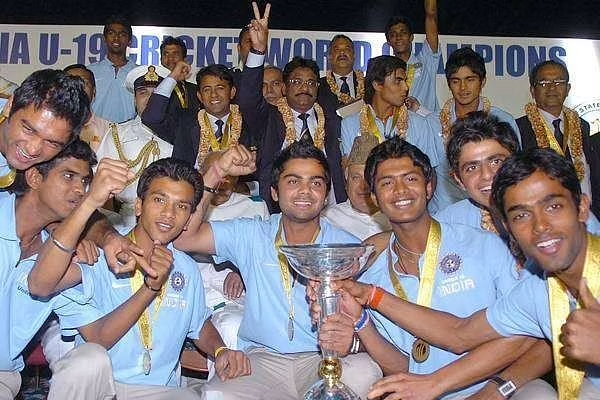
A spunky, chubby teenager with gelled hair shot to fame after leading India to glory in the Under-19 World Cup
at Kuala Lumpur in early 2008. In an Indian team filled with saint-like icons worthy of their own hagiographies,
Virat Kohli, with his most un-Indian, 'bad-boy' intensity, would clearly be an outcast.
In August 2008, Kohli was included in the Indian ODI squad for tour of Sri Lanka and the Champions Trophy in
Pakistan. Prior to the Sri Lankan tour, Kohli had played only eight List A matches. So, his selection was
called a "surprise call-up". During the Sri Lankan tour, as both first-choice openers Sachin Tendulkar and
Virender Sehwag were injured, Kohli batted as a makeshift opener throughout the series. He made his
international debut, at the age of 19, in the first ODI of the tour and was dismissed for 12. He made his
first ODI half century, a score of 54, in the fourth match. He had scores of 37, 25 and 31 in the other
three matches. India won the series 3-2 which was India's first ODI series win against Sri Lanka in Sri
Lanka.
After the postponement of Champions Trophy to 2009, Kohli was picked as a replacement for the injured Shikhar
Dhawan in the India A squad for the unofficial Tests against Australia A in September 2008. He batted only
once in the two-match series, and scored 49 in that innings. Later that month in September 2008, he played
for Delhi in the Nissar Trophy against SNGPL (winners of Quaid-i-Azam Trophy from Pakistan) and top-scored for
Delhi in both innings, with 52 and 197. The match was drawn but SNGPL won the trophy on first-innings
lead. In October 2008, Kohli played for Indian Board President's XI in a four-day tour match against
Australia.
Kohli, after recovering from a minor shoulder injury, returned to the national team replacing the injured Gautam
Gambhir in the Indian squad for the tri-series in Sri Lanka. He batted at number 4 for India in the 2009 ICC
Champions Trophy because of an injury to Yuvraj Singh. In the group match against the West Indies, Kohli
scored an unbeaten 79 in India's successful chase of 130 and was awarded man of the match award. Kohli
played as a reserve batsman in the seven-match home ODI series against Australia, appearing in two matches.
He found a place in the home ODI series against Sri Lanka in December 2009 and scored 27 and 54 in the first
two ODIs before making way for Yuvraj who regained fitness for the third ODI. However, Yuvraj's finger injury
recurred leading to him being ruled out indefinitely. Kohli returned to the team in the fourth ODI at
Kolkata and scored his first ODI century-107 off 114 balls-sharing a 224-run partnership for the third wicket
with Gambhir, who made his personal best score of 150. India won by seven wickets to seal the series
3-1. The man of the match was awarded to Gambhir who gave the award to Kohli.
Tendulkar was rested for the tri-nation ODI tournament in Bangladesh in January 2010, which enabled Kohli to
play in each of India's five matches. Against Bangladesh, he scored 91 to help secure a win after India
collapsed to 51/3 early in their run-chase of 297. In the next match against Sri Lanka, Kohli ended
unbeaten on 71 to help India win the match with a bonus point having chased down their target of 214 within 33
overs. The next day, he scored his second ODI century, against Bangladesh, bringing up the mark with the
winning runs. He became only the third Indian batsman to score two ODI centuries before their 22nd birthday,
after Tendulkar and Suresh Raina. Kohli was much praised for his performances during the series in
particular by the Indian captain Dhoni. Although Kohli made only two runs in the final against Sri Lanka in
a four-wicket Indian defeat, he finished as the leading run-getter of the series with 275 runs from five
innings at an average of 91.66. In the three-match ODI series at home against South Africa in February,
Kohli batted in two games and had scores of 31 and 57.
Grind through the ranks
He soon joined the senior Men in Blue in Sri Lanka, come August 2008. In the absence of the regular openers,
Virat Kohli was given a chance to open the batting in the ODI series. He played some commendable knocks in his
extended run as an opener, as India went on to win the ODI series. However, the established and formidable pair
of Tendulkar and Sehwag kept Kohli out of the team
a much higher level; that junior cricket was beneath his standards. Kohli then traveled to Australia in 2009 for
the Emerging players tournament and stamped his authority all over the bowling attacks. He added 'big-match
temperament' to his résumé too, lacing a fluent hundred in the final against South Africa, and guiding his team
to a clinical victory. The young prodigy, barely old enough to receive his man-of-the-match champagne, ended the
tournament with 398 runs from 7 outings with two centuries and two fifties, ensuring that he remained fresh in
the selectors' minds.
Cementing a national spot
The selectors had no choice but to give Kohli another go in the Indian side, and this time he strung together a
number of impressive scores. After being given an extended run, he repaid their faith by notching up his maiden
ODI hundred in an impressive run-chase against Sri Lanka in December 2009 - his first of many exemplary knocks
in run-chases. In the World Cup final of 2011, the biggest stage of them all, Kohli, along with his Delhi
teammate Gautam Gambhir, pulled off a largely underrated rescue effort with an 83-run stand after losing the
openers early. This knock played a crucial role in setting the platform for MS Dhoni's fabled knock of 91*,
which eventually won India the World Cup on that enchanting evening in Mumbai.
In the hangover of the World Cup euphoria, Kohli continued to take giant strides in the limited-overs format.
Three years after his ODI debut, he was finally handed the coveted Test cap in the Caribbean islands in July
2011, owing to the need to rest the senior players. After a series each against the Dukes ball and the SG ball,
it was now time for his trial against the Kookaburra Down Under. In the first two Tests, he seemed to lack the
technique to play in Australia, maintaining his low stance on the bouncy tracks. He also had a rather
restricting trigger movement with his front-foot routinely coming across towards off-stump, thereby hindering
the necessary movement to play back-foot shots such as the pull and the cut.